Geodesia is a European and American research lab, with labs in Bari (Apulia), Italy and San Francisco, California. Our work bridges geometric deep learning, mechanistic interpretability, and the safety of small open-source LLMs. Every output is a peer-reviewed paper and a production capability. G-1, our first commercial product, is live. The next — GLAD-Manifold, a physical, geometric reinvention of the Transformer and the foundation architecture for future AI and reasoning models — is in closed alpha.
A small open-source LLM can be downloaded by anyone, fine-tuned by anyone, and deployed by anyone. None of that solves whether its outputs are safe, grounded, explainable, or compliant. The trust layer is a first-class research artifact — it is what we work on.
Open and fine-tuned LLMs lag frontier closed models on safety by every measurable axis: jailbreak resilience, prompt-injection containment, factual grounding, refusal calibration. We close the gap at the runtime layer — without modifying weights — by reading the geometry of the model's own internal representations.
Our multilingual, multimodal encoder reads the prompt and emits independent OOD scores for prompt safety and jailbreak before the model is even called. The jailbreak head targets attack structure, not keywords; the prompt-safety head adds dual-concept boolean logic, firing when two individually-innocent elements co-occur (e.g. suffering ∧ means). On the English v4 OOD test, OOD AUROC 0.9204 on prompt_safety and 0.8623 on jailbreak; on the multilingual v5 test, 0.9892 and 0.8426 respectively — with false alarms bounded by split-conformal thresholds. Because all nine axes come from a single ~300M forward pass (28–30 ms ingress on an A6000, 2048-token prompt), the same gate is cheap enough to run on every agent step and — via a streaming transcription front-end — on every chunk of a voice stream, halting a spoken attack mid-sentence.
Streaming context-hallucination scoring with token-level spans, RAG-aware, plus a calibrated probability in [0,1]. OOD AUROC 0.8671 on halluc_context. A dedicated context-injection head (rag_jailbreak) reads the RAG chunks and intercepts hostile instructions hidden inside a file — 0.9405 OOD. Closed-book hallucination ships advisory-only: 0.769 OOD, single-pass and logprob-only — the lowest of the six labeled axes, and expected to be, since it has no source document to check against.
How these numbers are measured: entire datasets held out from training, not rows set aside — sources the model never saw in any form. Verified, not asserted: 0 shared sources out of 18 for the English test, 0 of 26 for the multilingual one, cross-referenced against this checkpoint's training-era corpus. Lower numbers than most published LLM-safety benchmarks — because those largely reward in-distribution memorization.
The cascade problem — one hallucination, or one poisoned tool, corrupting an entire multi-agent pipeline — is the single hardest open problem in agentic AI. Our research treats every agent hop and every Model Context Protocol (MCP) tool-call as a checkpoint: per-hop scoring with cryptographic credit assignment, plus allow / warn / block verdicts on tool discovery, calls, results and resources to stop tool poisoning, indirect injection and data exfiltration.
Full per-axis thresholds, enforcement defaults, and AUROC on both test sets: see the nine-axis table on the product page →
A systematic red-team loop — an adversarial probe library plus anti-regression recipes — closes gaps found in adversarial testing without regressing on benign creative content, under a gate that only ships an update if it does not regress the held-out OOD numbers above.
Plain-language user flags feed a curator review queue and an example bank; a weekly retraining with an automatic acceptance gate ships only if it does not regress. The trust layer improves with use — under human supervision — on three horizons: immediate (Policy Lens threshold change, hot-reload), fast (an approved correction lands in episodic memory, no retraining), and structural (an approved corpus feeds the next retraining). Policy Lens itself is a counterfactual simulator over real logged requests — an exact recomputation on already-logged scores, not an estimate, with ground truth taken from the customer's own reviewer corrections. Self-Evolving Security → · Policy Lens docs →
An optional 8B-class deep-scan (GLAD geometry over an open Apache-2.0 base) trades a little latency for higher OOD detection depth across the labeled axes; SLEDGE recalibrates closed-book per served model with a conformal false-positive guarantee.
A regulator does not want a heatmap. They want a mechanistic, auditable explanation of why the system did what it did. We have authored two peer-reviewed methods that meet that bar — both with mathematically guaranteed convergence, both shipping in G-1.
An N-dimensional, model- and loss-agnostic XAI methodology with mathematically guaranteed convergence. Validated on 1D audio, 2D image, 3D volumetric medical, and anatomical landmark detection. Unlike LIME, Shapley-value surrogates, or GradCAM, MuPAX preserves — even enhances — model accuracy when masking, because it captures only the truly important patterns.
A deterministic, model-independent method for extracting only the signals a black-box model recognizes as important. Mathematically proven convergence. Designed for time-varying signals (audio) and extensible to images, video, and 3D. Validated on COVID-19 audio diagnostics, Parkinson's voice recordings, and music classification — outperforming LIME, Shapley-value surrogates, and GradCAM on almost all metrics.
We only ship XAI methods with formal convergence guarantees. Heuristic post-hoc explanations are not court-quality evidence and we do not pretend otherwise.
Explanations are derived from the model's own internal states — gradients, attention, hidden activations. No surrogate models. No rationalization layers stacked on top.
Three speed tiers in production: Occlusion (3–8 s, fast scan), Integrated Gradients (60–120 s, axiomatic), MuPAX (30–180 s, court-quality).
GLAD-Manifold — Geometric Learning of Action Dynamics on Riemannian Manifold — is our next commercial product and the foundation architecture for the AI and reasoning systems that will follow the Transformer. It reinvents attention as a physical interaction field over a curved representation manifold: not a fixed similarity computation, but a context-adaptive geometry that the network learns end-to-end. The same machinery that gives it a strictly richer hypothesis class also gives it the ability to act as a world model — to internalise the dynamics of action, state and consequence — which is what the next wave of reasoning systems requires.
Where conventional Transformers expose a single, rigid mechanism for token interaction, GLAD treats the very shape of that interaction as part of what the network learns. The result is a strictly richer hypothesis class with markedly stronger compositional and generalisation behaviour, while preserving the operational profile that production deployments depend on.
Three consequences matter most. The architecture's interaction surface adapts to the task, rather than the task adapting to the architecture. Pre-trained checkpoints from the conventional Transformer family transfer into GLAD without retraining. And — most usefully for our applications — the geometric structure exposes natural intrinsic loci where trust, safety, grounding and alignment can live as properties of the representation, not as filters bolted on top.
Rather than fixing the way tokens influence each other up front, GLAD lets that influence be shaped by the data and the context — at every layer, every step. Capacity to express structure the conventional architecture cannot reach.
The conventional Transformer sits inside the GLAD family as a particular limit. Existing pre-trained checkpoints transfer in directly — turning every model already in production into a candidate base for our trust layer.
The architecture's geometric structure exposes natural intrinsic positions for trust, safety and grounding mechanisms — earlier signal, lower latency, mechanistically grounded inside the representation rather than stacked on the output.
G-1 is the first commercial output of the lab. Each subsequent product takes one of our research thrusts and ships it as enterprise-grade infrastructure.
Non-invasive, real-time runtime that wraps any open-source LLM (via vLLM and friends) or streaming voice/audio pipeline. Powered by our proprietary multimodal physical model: frontier-grade safety, hallucination control, and auto-generated auditable compliance documents for the EU AI Act, California SB 942, and 11 other AI frameworks. Live with enterprise design partners across financial services, insurance, and healthcare.
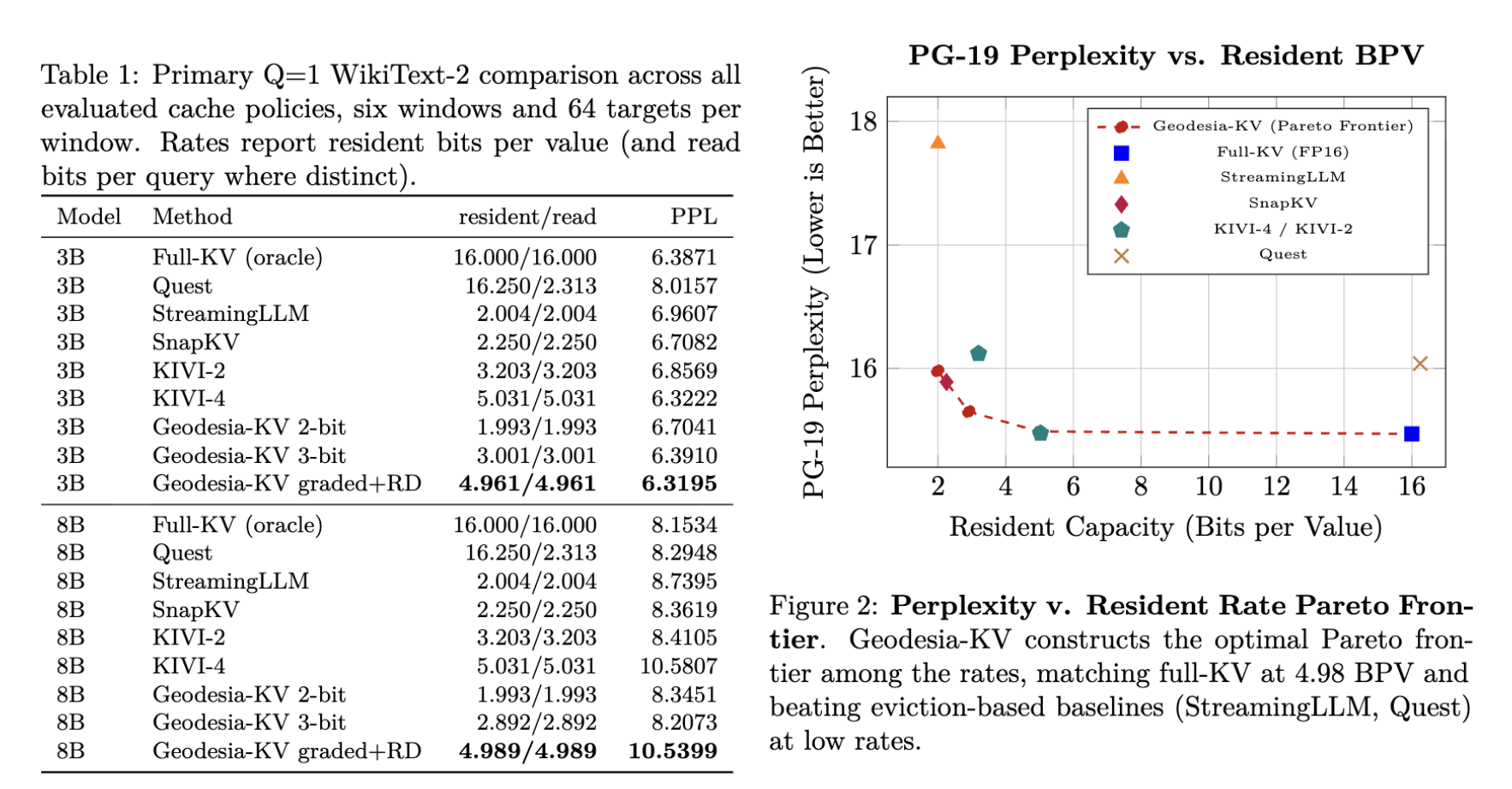
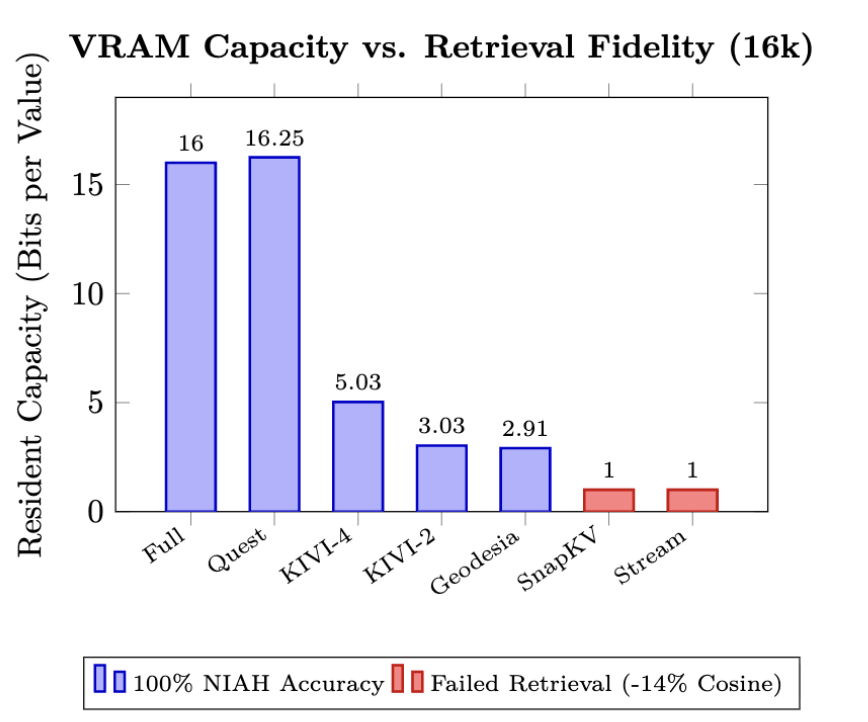
Vincenzo Dentamaro, Pancrazio Auteri, Giuseppe Pirlo. A training-free, certified KV-cache compression framework built around monotonic equipotential allocation — a rate-distortion Lagrangian allocator that assigns graded, variable bit-depth to each cache block by causal attention mass and value distortion, instead of evicting tokens or quantizing uniformly. It unlocks theoretically near-unbounded context windows on commodity GPUs, ships as a native vLLM plugin, and comes with a runtime error certificate bounding output attention error. Being open-sourced by Geodesia — paper and repository link to follow at release.
A reinvention of the Transformer: physical, geometric, and built on a learned Riemannian manifold. Where the conventional Transformer fixes a single mechanism of token interaction, GLAD-Manifold lets the very geometry of that interaction be learned end-to-end — yielding a strictly richer hypothesis class with markedly stronger compositional and reasoning behaviour, and the ability to act as a world model capturing the dynamics of action, state and consequence. The architectural foundation for the AI and reasoning systems that come after the Transformer. Closed alpha with research partners.
The natural commercial endpoint of the architecture: a frontier-class reasoning model trained natively on GLAD-Manifold, with safety, grounding and alignment expressed inside the representation space from the very first token. European-built. Sovereign-deployable. Aligned by construction. We will ship when the science is right.
Vincenzo Dentamaro, Giuseppe Pirlo
N-dimensional, problem- and loss-agnostic XAI methodology with mathematically guaranteed convergence. Outperforms LIME, Shapley-value surrogates, and GradCAM across audio, image, volumetric medical, and anatomical landmark tasks.
Read paper →Vincenzo Dentamaro, Giuseppe Pirlo
A deterministic, model-independent XAI method with mathematically proven convergence. Validated across COVID-19 audio diagnostics, Parkinson's voice recordings, and music classification.
Read paper →Geodesia-KV, our KV-cache compression paper, is in the Product Roadmap above →
Full publication list, talks, and reading recommendations from the team. We collaborate with researchers globally — please reach out.